Monday, 13 January 2014

Quite alarming

Today I overslept. Really quite badly, actually. I got up with my alarm at 08:00 and had resolved, last night, that I would spring out of bed this morning. Unfortunately, my resolve deserted me in the night and I put it on snooze. The alarm went off again, I turned it off, prepared myself to get out of bed and promptly fell asleep, waking up at 09:30. Since my class started at 10:00, I decided to give it a miss and take the opportunity to miss another, later class in the same subject, too. I did, however, get up at 13:00 and made my way in for a 15:00 class.

I got to ROV at about the perfect time, having managed to find time to print off some necessary things, check my e-mails and buy a drink - I am just so much better in the afternoons. Need to find a job working nights :P Anyway, I boarded the train, changed at WOO, no problem. At STR (Stratford) a gentleman with some shopping rushed onto our train and stood about for a bit, before deciding that he didn't like the train very much and wanted to get back onto the platform as the doors on the right (the doors on the left having already closed) were closing. To achieve this, he stuck his arms in the doors, trapping hands and shopping outside of the train and the rest of himself inside it. If the T/Op happened not to notice this on the CCTV monitors, they would have been alerted to the actions of the moron by the lack of a doors closed visual (or "pilot light"). The pilot light illuminates when all doors are proved closed. The train cannot depart until all doors are proved closed, as an obviously important safety measure. If the doors are proved closed, the pilot light illuminates and the train can leave (obviously subject to various other conditions as well, such as a clear signal). Obviously the moron needed to be released from the doors before we could leave, so the T/Op reopened the doors, tried again to close them and we were on our way.

Incidentally, this is what's involved in the jerking many Central line (and other lines, too) passengers will have experienced when leaving stations. When people lean on the doors, they can be pulled open, causing a loss of the interlock (and the doors closed visual) and the brakes apply automatically, in the hope of preventing anyone with clothing caught in the doors from being pulled along the platform or anything like that. We had quite a few interlock losses tonight (and resulting jerky starts), actually.

Also, as a little aside, I remember once when we were coming into CHL (Chancery Lane) westbound, the train pulled up pretty sharpish, having braked very hard. This, as I very soon learned, was due to an emergency brake application. As the T/Op informed us:

"Sorry about that ladies and gentlemen, the emergency brakes have just come on for, er, no reason at all. It's gonna take me a few minutes to reset everything and then we can pull in the rest of the way."

After a bit of a wait, we pulled in properly, and were told that people had been leaning on the doors on the way. We were reminded that the computer doesn't like that and asked to try and avoid it. Made for an interesting morning, although a slightly hairy one as I had an exam and was a little nervous about how long we would be waiting (in the end, not long at all :P)

Anyway, all of this kit is obviously very important for making sure that people don't get hurt by the doors and, most importantly, don't get themselves trapped and dragged along. I did, though (while I'm on the topic), recently read an RAIB report into an incident at Warren Street where a train departed with all the doors on the platform side open (report). In short, what had happened is that a sensitive edge system (new to the Victoria line and its 2009 stock) had activated at OXO (Oxford Circus) and the T/Op had been unable to reset it successfully. In fact, this system was initially very temperamental and, I believe, has since been updated. On most lines, including the Central, a simpler approach of providing some give in the doors (hence the jerking when they pull open) is used. This allows people who get clothing and stuff caught in the doors to simply pull themselves free. However, this approach was not practical on the 2009 stock, because the doors were too heavy and their own momentum was pulling them open under emergency braking. To remediate this, a highly sensitive sensitive-edge system, used to detect clothing trapped in the doors and such, was employed. This provided the necessary safeguard against people getting trapped, as it prevents the train from departing when activated. Anyway, the T/Op had not been able to reset the system properly and, in his confusion, had eventually disabled the train door interlock system and the round train circuit. These actions meant that the train could depart without the doors having been proved closed. In the stressful situation, the T/Op neglected to close the doors or observe the status of the door closed visual. The train pulled away with its doors open and they were closed by an automatic safety system, but not until some of the train was already in the tunnel. Upon becoming aware of a problem, the T/Op applied the full service brake and then the emergency brake and brought the train to a halt. It was then evacuated by station staff - the super having behaved, as far as I can tell, laudably. Nobody was harmed, but I thought the report into this extremely unusual occurrence made for interesting reading.

Anyway, anyway, after STR we made it to LIS (Liverpool Street) with no problems and I changed onto a Circle line train. At Moorgate our train was joined by a visually impaired person, assisted onto the train by a member of station staff. He arranged for her to be met at King's X (her destination) by a member of staff, who was there waiting for her when we pulled in. Between Farringdon and King's X I went over and checked that King's X was her destination, made sure that she was aware we were approaching King's X (information on the S stock is pretty good and I imagine it's much easier getting around the Met these days than it would have been on the old A stocks!) and asked if she'd need any assistance getting off. She said she'd be fine but asked if I could just keep a look out of the member of station staff who was, indeed, there and came over as I was going over to him; so there wasn't much for me to do. She described London Underground as "excellent" when it comes to providing staff to help people around stations so, TfL, take note - you have a satisfied customer for as long as there are human beings on hand to help your pax.

On the way back, I arrived at Euston Square in time to board a Met line train that thought it was for all stations to Watford. It was not for all stations to Watford, neither was it a semi-fast Watford service as it soon decided it was. A few people jumped off, falling foul of this, before the T/Op corrected it and it told us that the destination had changed and that it was now a Metropolitan line train to Aldgate - which was correct :P

LIS was mobbed. I arrived on a very busy platform with four minutes to wait for the next train (a WOO via HAI) - I can only assume there must have been some small problem or another. The automated announcements were telling us there was a good service operating on all lines, but the control room had to warn people to move down, away from the exit, or they'd have to consider non-stopping trains, for safety reasons. Happily people did move down. I'd already made my way as far along as I could and was, conveniently, just about able to get on the WOO train, which was nice. Very warm and crowded, though, but I quite enjoyed the journey all the same.

This, of course, meant going via HAI and one thing I've been meaning to mention is my dislike of BAR (Barkingside) in the dark. It's a perfectly quaint and pleasant station during the day, very nice in fact:
Barkingside station looking very nice in the daytime. (Image courtesy "Sunil060902" (via Wikipedia))
But, the lights which they've fitted give the station a horrible feel at night. I really don't like it. They're a bit like floodlights, giving off a bright, white light, which gives the place the feel of a ward of some kind, or perhaps a subway. And yet, the light doesn't actually penetrate very far, so - although the lights themselves are bright - the actual station is quite dark and very poorly lit. Not nice.

Anyway, after BAR it was all quiet - and very quick through HAI (Hainault) and GRH (Grange Hill) (I noticed the cleaners didn't work on the train at HAI tonight). Bit busier than usual, mind. But we pulled into ROV very promptly, where it was raining, which was not nice :(

Thursday, 9 January 2014

This is dud central

It was a really lovely day today. I'm quite lucky, in some ways, since my timetable has now changed and I only have one class today, which is 16:00-17:00. Since my commute works out to a ≈2-2.5 hour trip, this is a bit of a nuisance - and it means a journey home at rush hour - but it also means a lie-in and a nice, relaxing afternoon journey in. I wasn't feeling that terrific when I got up, but I looked out of my window to a truly beautiful sky, which really lifted my spirits. I then had a lovely journey in on a glorious winter's afternoon. Therapy :). Actually, there's nothing like a tube journey to cheer me up, I once took a trip up to High Barnet and back after a good friendship sort of collapsed.

Anyway, I arrived at ROV with 5 minutes to go till the WOO train and 3 minutes until a "special" arrived. "Special" usually means the train is out of service and, sure enough, another out of service train came through ROV 3 minutes later. My title for this entry is obviously a bit tongue-in-cheek and it may not have been a dud, but I'm pretty sure it was, since the seats in one of the carriages had been lifted up to allow access to the various electrical equipment there. Well, either way, it actually had a bit of a wait at the starter signal until the train from BUH (Buckhurst Hill) had cleared Woodford junction, but it was soon on its way. By that time, the WOO train had arrived and, having been held just short of ROV, pulled in shortly after. We then followed the out of service train onto WOO, where it was performing a main line shunt (see Woodford station and, also, yesterday's blog post, where I describe a similar move at LES (Leytonstone)). This means that it had continued out of westbound platform 2 and stopped on the main line. This, of course, leaves 21 road free for our WOO train. Our train was duly detrained and proceeded into 21 road. Clearly, the out of service train couldn't move into eastbound platform 3, and then round to HAI (Hainault) (where I assume it was going), until our train had stopped in the siding. When the WOO train was safely out of the way, the out of service train got going, but not before the NOR (Northolt) train was pulling into westbound 2. This train, obviously, had a bit of a wait while the out of service train made its way over the crossover into eastbound platform 3 (which I stood and watched), before it got me on my way.

Now, I'm sure I'm missing something, but I've gotta confess this does strike me as a little odd and I'll tell you why. After everything I said yesterday about reversing at WOO being the thing I would do, you'd've thought I'd be applauding this as the sensible move. (It has just struck me (and I've added a quick edit just in case) that the train I was talking about yesterday could have carried on through WOO and reversed at LES, to go back round to the depot via WOO. This would allow Wood Lane to take advantage of the additional platform at LES, but obviously means a fairly unnecessary extra journey.) And, certainly, I think WOO is an ideal place through which to route trains bound for the HAI depot. However, what leaves me puzzled is this: This train was approaching WOO on the HAI loop, so I can only assume it failed somewhere between GRH (Grange Hill) and WOO - anywhere else on the HAI loop and it could have been worked into the depot from any platform at HAI, or - I do believe - either platform at GRH. Obviously, there're no restrictions on where a train can go wrong, but I'll be a little surprised if it did fail between GRH and WOO, because a working train arrived so quickly afterwards, and on time. Given that trains are only timetabled along that part of the line once every twenty minutes, I would have thought pulling that off would mean finding a train to continue on from HAI to WOO pretty quickly and it would've had to go like the clappers to catch up with the train it was substituting in for (which presumably wouldn't have been running that early when it failed?) Oh well, maybe I should leave the speculating alone for the time being, I've not the faintest idea what happened there, but let's just say I find myself struggling to explain what went on today. Not that I'm complaining, I enjoyed the unusual move and this is exactly the sort of thing I started blogging to talk about.

Anyway, once I was on my way, it was a fairly straightforward journey into LIS (Liverpool Street) on a day which really made me feel jealous of our Central line T/Ops. It was a marvellous day to be on the trains. Goodness knows LUL can be an impossible company to work for sometimes and I often think that if the people in 55 Broadway have their way, it really will be an impossible company to work for some day, at least in front line services. More and more people are being replaced by machines and I, for one, am very saddened by this. Ticket office closures have led to the loss of large numbers of jobs - and not just in the ticket offices - the number of humans on stations seems to be coming down and I get the feeling we will have more unmanned stations at night (especially with the coming of the "night tube") than ever before soon. (Fire regulations mandate a certain number of staff at underground stations and, realistically, no railways is ever gonna be fully automated, but I fear we're tending towards that with time. Or, at least, we will continue to do so, until there's an almighty catastrophe like the King's Cross fire and suddenly people are wondering why there weren't enough people taking charge and sorting it out). I feel I should write a long-winded rant in the light of articles such as these, but I can't really bring myself to do it. It just makes me feel quite sad and I'm a bit too busy.

But, in spite of this, for the time being, I'd give quite a lot to be paid to be on the front of a tube train on a day like today, especially "on the handle". One thing that does seem to be a foregone conclusion is that the eradication of people on the handle (in normal operation anyway) is the plan. Not that this objective is proceeding fantastically smoothly and we've recently had the news that the contract to convert the sub-surface lines to ATO has been re-let. Bombardier have lost the contract and it seems that their 'Cityflo 650' system will not be used. This makes the 2018 deadline date seem pretty unrealistic now. Also, while this may be the dream, my whingeing about TBTC on the Northern and Jubilee lines will be familiar to anyone who's been reading regularly and take a look at ASLEF shrugged's blog, if you haven't already, to learn what happens when you mix rain with a Central line train in auto. Despite what some may want to believe, the tube isn't a glorified roller coaster and, even in the early days of 2014, we've a long way to go before truly 'driverless' trains are running. This, though, is the plan, and while we might well have cause to be sceptical about it (see title of this blog alone :P), City Hall's war on the T/Op doesn't look like abating any time soon.

Mini-rant over. LIS. Changed for a Met line train (all stations to Uxbridge) and passed an S7 sat in Moorgate platform 4, which was out of service. (May not have been dud, of course, but 'dud central' worked better than 'out of service central' :P) That was about the only thing of note, though, and I arrived in class very early. My class was on the fifth floor, though, and this gave me a wonderful opportunity to sit and stare at an enchanting sky as the Sun began to set and the rain clouds were lit from below. How lovely.

And then it was back home. Little slow on the Met around Barbican but, otherwise, fairly smooth journey. Changed at LIS for a HAI via NEP train, changed at LES for an EPP train and changed at WOO for the HAI train. Quite a long, warm journey - as you expect at rush hour - but quite a happy one too. And that's the end of my week - no class tomorrow, so I'm free as a bird :)

Wednesday, 8 January 2014

Some Leytonstone observations

Timed it perfectly this morning. Well, sort of. Actually, by the time I extracted myself from the cosy depths of my bed, I knew it wasn't looking likely that I'd make the earlier train and I didn't. Resigned to the necessity to take the later train in, which I anticipated should turn up somewhere around 09:10-09:15 (timetabled to arrive at 09:14, but I don't necessarily recommend setting too much store by that), I took my time a bit more, checked my e-mails and all the rest of it and left at about 09:05. I got to ROV without any need to jog at all and only had a 3 minute wait for the WOO train, which was nice.

On the walk to the station I noticed a train heading towards HAI (Hainault), which looked to me like it was out of service - its lights appeared to be off and there didn't seem to be anyone on it (not that the HAI train is usually packed to the rafters anyway). Also, I'm sure no train was due for a little while and one that was in service did arrive shortly after. This reminded me that I'd meant to mention that, while at WOO yesterday, wondering when my train would arrive, I saw a train that was out of service trundle through on the westbound. (It's hard to remember everything I think I ought to mention sometimes :P) Now, being a geek, this is the kind of thing that generally makes me prick up my ears and take note, even though it's really just another train (at least, from the outside it is, although I once saw one with a broken window), which just happens to be substantially less useful to the pax (passengers). This time in particular, though, I was actually rather surprised, as the nearest depot is at HAI, which is surely where you'd want it, in order to do any repairs. The others are at White City and Ruislip, both of which are long journeys away and I can't imagine Wood Lane would want an out of service train to do that trip, so the obvious thing to do would - I would think (remember I just get on 'em) - be to put it in the HAI depot. Now, the shortest route to HAI depot is to go in at GRH (Grange Hill) via ROV. It would have made a lot more sense to me to reverse this train off westbound platform 2 and send it round via ROV to the depot. The reason for this is that WOO westbound was not very busy at that time of day, the next train wasn't through for a little while and it's a much shorter trip. Continuing on the westbound through WOO would either mean carrying on all the way to White City or Ruislip, or reversing at LES (Leytonstone) and going round via NEP (Newbury Park). The problem here is partly the longer journey and that LES is a lot busier - both in terms of the number of people who want to get somewhere and who won't appreciate their platform being visited by a train they can't get on; and in terms of the number of trains that will have to queue behind the out of service train as it reverses. Mostly, though, it's that trains from SNA (Snaresbrook) westbound cannot reach eastbound platform 3 (which is the only platform from which trains can go to WAN (Wanstead) and on to HAI via NEP) without doing a "main line shunt".

The track layout at Leytonstone. Notice how the eastbound route towards Wanstead can only be reached from eastbound platform 3 (EB3)
This basically involves stopping and changing ends on the main running track to LEY (Leyton); rather than in a convenient platform or siding - meaning trains have to be routed round the reversing train. Not a huge problem at LES, since you have two westbound tracks; but it does seem rather a hassle, when the train could have been reversed at WOO. Additionally, as you can see, the main route from WB1 (which is the one that'd have to be used, as the main line shunt would probably be carried out on the main route from WB2) is not accessible from WB2, so WB2 could not be used for westbound trains until the move was completed.
I'm not massively familiar with all the procedures at LES, but - to clarify - my understanding of the procedure that would be followed to get any train from the EPP (Epping) branch to the HAI depot is as follows (remember this may not ever have happened, I had no way of checking, I was just standing on the platform, but I hope it makes an interesting few paragraphs :P). The train would arrive from Snaresbrook on WB2. It would then be cleared all the way down to the limit of shunt sign, which - I believe - takes the back of the train past the shunt signal to the west of the platform:
A train performing a mainline shunt is cleared out of WB2 by the starter signal. It will then proceed to the limit of shunt sign
The train would then, I believe, be cleared by the shunt signal into eastbound platform 3 over the crossover highlighted in blue:
The (mysteriously shortened - sorry) train is cleared by the shunt signal into EB3 via the crossover shown in blue
Well, I'm sure there was a (good) reason for the train not reversing at WOO, I'd just be interested to hear it, because the route seemed strange to me :P
Anyway, this morning. Changed at WOO; had a quiet, pleasant journey into LIS (Liverpool Street). Actually we had a change of T/Op at LES (perfectly normal) and our new T/Op was quite chatty - wished us all a good morning and everything, which was nice. Anyway, changed at LIS. Had a quiet, pleasant trip on the Circle line (S7, I'm happy to say, though I spotted two more C stocks) to King's X and arrived in class barely 5 minutes late. The only thing of any real note is that I did notice a Met line train to Wembley Park behind ours. This is, I do believe, a perfectly regular, timetabled service and quite a few Met trains in the morning peak do terminate at Wembley Park. Not very many do at other times of day, though, so - with my interest in Met line workings - it was nice to notice it :P

On the way back, I ended up going from Russell Square, meaning - of course - a brief spell on the Picc to HOL (Holborn), before heading off along the Central line on a HAI via NEP train. This obviously meant having a run over the busy section from HOL to LIS - which I usually miss out - so that was nice, if cramped :P I do like pulling into BAN (Bank) station, I must say. After that, it was warm, but plain sailing all the way to LES, where I changed for the EPP.

On the subject of uncommon moves at LES, I noticed the train in WB1 was cleared on to LEY via the crossover immediately outside WB1, rather than the more usual straight route, which merges with the track from WB2 just before the end of my diagram (see Variety is the spice of life for more detials). I also noticed that the poor member of station staff doing SATS had a dodgy tannoy. Bit of a pain, I imagine, he looked quite fed-up.

Anyway, I got to WOO and the HAI train hadn't even arrived from ROV, so the journey wasn't exactly seamless - and it was cold. But oh well, the wait goes quickly enough for me. Woulda been nice if we'd had a bit of coordination, though, I might have made the previous HAI train. I'm not one to whinge about my Central line too much, I'm a forgiving sort of a commuter, who understands that things must be tricky to manage in the control room and not everything is within Wood Lane's control. However, I noticed at LES that the service at that point was HAI via NEP (the train I got off), NEP, EPP, EPP, WOO via HAI. This two up the same branch situation was supposed to have gone with the last timetable change so I can only imagine something went a bit wrong. Bit of a pain for me, but oh well, I suppose the fresh air was nice :P

At WOO, I noticed that there were two members of cleaning staff on the platform (WB2), who boarded the train when all the pax were being detrained and stayed on it into the sidings. They then, of course, clean the train in the sidings - a fine idea, which has been done for ages at NEP, if I'm not mistaken, and is common practice in many other places. I'm pretty sure it's new to WOO, though; I thought I saw it a few days ago, but that was the first time I'd seen it. This is a pretty good idea, as the WOO trains are usually cleaned at HAI and if they get rid of that (and the associated short dwell there), it'd really smooth the journey home via HAI out. They hadn't done that on Monday (last time I went through), though.

I also noticed a WER (West Ruislip) train arrive in WB2 which was fine as it approached, but then I saw all the lights go out in the saloons, apart from the emergency lights. I've seen this before, and I'm sure I've read about situations that can cause it, but I'm afraid I can't really remember what those are :P Still, as it pulled out, all lights but the emergency lights were off and so was the destination display on the rear cab. I think the rear cab light might have been off too. Wonder what caused it. It's not a huge deal and probably gives you a slightly better view out the window, as a passenger, but it's not ideally pleasant. Sadly the T/Op has no way of knowing what's happened to fix it. Often that can mean it doesn't get fixed until a change of drivers, or until the driver changes ends, unless someone manages to get the message to them.

Anyway, the HAI train arrived nice and promptly and I was back home in no time after that.

---

Unrelatedly, while writing this, I seem to have trapped a crumb or bit of dirt or something under my <t> key, which means it isn't registering my keystrokes very well, so I'm signing off to fix that. Gonna have to get a screwdriver out I think, wish me luck, or I won't be blogging for a while :P

---

A quick edit: I suppose that out of service train which passed through WOO could have been reversed (presumably off westbound platform 2) at LES and sent back round to HAI via WOO. A possible explanation for this is to make use of the three platforms you have available at LES - no need for a main line shunt at all. The main question, though, for me is why bother? WOO was quiet at that time; LES wouldn't have been nearly as quiet and it's a bit of a pain working all westbound trains into WB1 around the reversing train. Obviously, it also adds to the journey of the dud, but I'm sure they had their reasons.

Tuesday, 7 January 2014

Refurbishments

I timed everything much better this morning and ended up getting to ROV with a brief wait for the next train. Happily, this next train was one of the last (might even have been the penultimate) through services and was bound for WER (West Ruislip). It really does make the journey much faster and much smoother having the through train (it was a little busy mind you). In fact, all in all, it was a very smooth trip - we were driven "on the handle" (i.e. in coded manual) "upstairs" and it really did make a nice change. I was a little tired and sleepy, but it was generally a nice trip and I happily took a good look at the crossover at BEG (Bethnal Green) and the reversing sidings at LIS (Liverpool Street), since I'd had to stand :P

Speaking of LIS, whatever improvement works they were doing have been finished, which is very nice (well some of them, I don't now about any others). As of today, I believe, the area at the top of the escalators from/to the Central line is all shiny and new. Something tells me - although I could be hopelessly wrong - that the control room used to be there and I'm sure it used to have clear glass windows. Whether or not the control room still is there, I have no idea, but it's all solid wall now, with a few doors leading to whatever's there. Still, it's nice to have a bit more space. I was also delighted to see that they've finally reopened what used to be the main entrance/exit at King's X (I think it was called the Euston Road exit - might still be, or at least one of the Euston Road exits). I don't know when they did this, since it's the first time I've been there in three weeks, but it was due to re-open months ago (maybe October?) and was delayed, which used to mean a little bit more of a walk from the sub-surface line platforms to the new entrance/exit. Actually the new one is nice, and the whole redevelopment going on there - making it much more spacious - is rather pretty. You can also see straight through to the mainline terminating platforms from the street and concourse. It is lovely, but I'm definitely glad to have the old entrance back as well - eases up the traffic a bit as well.

Anyway, where was I? LIS was actually a lot less busy than I was expecting - another plus - and I was able to board the first train through - a Met line train for all stations to Watford. I probably wouldn't have been able to get on a Circle or H&C train, to be honest, mind. This took me all the way to King's X, where I was disappointed to see a C stock standing in the opposite platform, just as I thought I'd be able to go another whole journey without seeing one of the blighters. Saw one on the way back too :P

Anyway - the way back. Slight wait at King's X for a Barking-bound H&C train. Changed at LIS for a LOU (Loughton) train to WOO. Simple, pleasant journey as the weather was clearing up. Lovely. At WOO, though, we've been having problems with the destination indicators and the one on EB3 wasn't showing anything at all this morning. I had a couple of lads ask me where the LOU train was going as I stepped off, since they'd been in the waiting room and obviously had no way of knowing its destination. Very odd it was, standing on the platform, looking at the HAI train in 21 road without the first clue as to when it would be coming out. Of course, the helpful CSA did make an announcement as it pulled in (well, I say CSA, I'm not really 'in the know' about who holds what grade at WOO station and there's gonna be a big reshuffle with the 'night tube' and its attendant ticket office closures and station staff alterations anyway, but, whatever his job description, he was on hand) and I - not having sat in the waiting room - knew where it was going when it did arrive, anyway; but it's nice to know how much longer you're gonna be in the cold for :P I hope they get that fixed soon. Those boards at WOO do seem to be some of the more temperamental ones. Though I think they were broken at BEG EB yesterday, as well.

Monday, 6 January 2014

Back to class

Term has resumed and that means I was due back in class bright and early at 10:00 this morning. Unfortunately, though I turned up on time, the weather got held up and instead of being bright and early, 10:00 was miserable, damp and early. To achieve this feat of punctuality, I had to get up at 08:00, when I'm used to getting up at about 12:00. Not good. I didn't get much sleep last night - not used to going to bed so early. I tried to ease myself into it - watched some darts (good matches) before going to bed - but it was no use, I was terribly groggy and tired this morning. But no matter, despite last minute essay printing, I made the early train into WOO. I don't know when it arrived, the departure boards were showing that it wasn't due to leave for another 2 minutes when I turned up, but it was already sat in the platform. I was quite taken aback, actually, it's not normally that early. I'd noticed the HAI train leaving as I neared the station and was hoping it was simply early, or unusually punctual (the HAI train is timetabled to leave a couple of minutes before the WOO train, but it very often doesn't and sometimes leaves after it, which is why I was hoping it was early - or, at least, on time - otherwise it could have meant that I'd missed (or was about to miss) my train; either way it meant I was cutting it fine). I hurried into the station and was disappointed to see the WOO train sitting there, until I noticed it wasn't due to leave for another two minutes. So I made my way quickly (but, this time, calmly and safely) onto the platform and you can be sure I took extra care getting on and off Central line trains this morning, since the rain was back with avengeance and had left me soaking. Not an ideal start to the term that. Anyway, happily, this one really was an early train and there was no need to rush, it didn't leave for another minute or so.
 
After that it was perfectly plain sailing all the way into LIS (Liverpool Street). There, I changed onto a Circle line service to Hammersmith. The Circle line had been part suspended (no service in one direction, I think it was anti-clockwise) when I left home this morning, due to a signal failure at Tower Hill. That had largely all cleared-up on the Circle by the time I got to Euston Square, though, but the Hammersmith & City and District lines had minor delays. Anyway, it was a very nice journey, the T/Op was stopping beautifully smoothly - far, far better than I can ever manage on OpenBVE :P I happened to notice, across the platform, a train bound for Moorgate sat at the eastbound platform as we pulled into King's X WB. I assume this was 'cause of the signal failure. All was well on our train, though, and although it was absolutely chucking it down at Barbican, come Euston Square you could even see blue sky. I managed to avoid another deluge and it was actually quite a nice walk to class. Good to be out of the house again, anyway :P

On the way back home we had minor delays on all three of the Met, H&C and Circle lines due to an earlier signal failure at King's X. We were, therefore, a little slow, although it was rush hour and it does usually get a bit congested around there anyway. We were held at red signals at King's X and Barbican, but nothing major. I did happen to notice a person in a hi-vi standing on the disused platforms at King's X, which is a little unusual. I also saw a Circle line train in platform 3 at Moorgate (which can only've been due to the delays) and, even more conspicuously, not a single C stock. I don't think I saw one at all, not in either direction, so I suppose the phasing out is progressing at a fine pace. Changing at LIS, I just missed an EPP (Epping) train due to the traffic, but the next train through was for WOO via HAI, so I just stayed on that. It is a nice journey, took the chance to stretch my legs and get some fresh air at HAI and then we had a bit of a dwell at GRH (Grange Hill) before we were finally on our way. I also noticed a District line train bound for Dagenham East at Mile End. This could well have been one of the one's that is timetabled (maybe the 17:53? I didn't check my watch) so it's far from unheard of, a fair few do reverse there, but it's very much a peak time feature and I don't usually see them, so it made a bit of a nice change :P

Wednesday, 1 January 2014

High Street Kensington

Today, I was meeting a friend for lunch at High Street Kensington. Today, it was also raining. As is becoming something of a recurring theme in the world of TUT, the WOO train beat me to ROV and it was happily sat in the platform by the time I made it. Having learned from past experience, I didn't dawdle, but didn't hurry either, expecting it to pull off without me. I made it over the bridge and onto the platform with it still sitting there and touched in. That's when the doors started peeping. So I broke one of my own rules and made a bit of a dash, since the train was so close and it was such a long wait for the next one. I made it through the doors - result - and promptly skidded on the floor that was wet from the rain. I did manage to stay on my feet, but left my dignity on the platform and frightened a fellow passenger somewhat. My own fault. Take care out there, "platforms and stairs may become slippery when wet" and so, it seems, may trains. When they say stand clear of the closing doors, stand clear - you risk doing yourself an injury and damaging the doors, which'll eventually break them and the train'll need to be taken out of service. Not a good thing. Normally, I would practice what I preach, but today I took the opportunity to reinforce the lesson for myself :P Certainly, it's not a good idea to make a mad dash - scattering fellow commuters - in the middle of the city when the next train's 1 and a half minutes away. I like to think my faux pas was a little more excusable, but still. Lesson sort of learned.

After that, it was plain sailing all the way to Notting Hill Gate (which is definitely NHG (I checked :P)), which is a real favourite of mine and I was delighted to have a look round such a beautiful station again. Some of you may remember this picture from post 1:
Notting Hill Gate on the Circle and District lines. (Image courtesy "HTUK" (via Wikipedia))
Quite a treat for me :P I was early so I  let a Circle line train go and then boarded a District line train to Putney Bridge. Regular readers may also remember that these are rare during the week, so that was also nice. On Sundays and public holidays, though (which I imagine was the reason for mine today) they're a lot more plentiful.

High Street Kensington is, of course, just one stop away and is also a fascinating station, with bay platforms used for terminating trains (when the shuttle to Kensington (Olympia) is running (which it wasn't today, I believe), it usually terminates here and other trains can be short turned here if necessary). There're also the triangle sidings out of sight just outside the station. Anyway, it's a lovely place to be, too:
High Street Kensington. (Image courtesy "Oxyman" (via Wikipedia))
Consequently, I stayed there and let a couple of trains go by before heading off to the restaurant, arriving just slightly early. Perfect way to adjust the timings :P

Well, anyway, it was a lovely afternoon and then we were back on the trains just as things were starting to go wrong on that part of the line. I'm not sure why, and can't remember the full extent of the problems, but i believe there were big problems (possibly no service at all) on the Circle line anti-clock and minor delays clockwise (not so bad as we needed to go clockwise). The District was also out of action between Earl's Court and Aldgate East unless I'm very much mistaken. Actually, I could be wrong, but I think it might have been a signal failure at Embankment that was the culprit. Well, whatever the case, it meant a slight wait at High Street Kensington, during which a D stock train arrived and terminated on platform 4 (the second of the two bay platforms, which can't be easily seen in the picture above, but is to the right of those blue railings on the extreme right, here's a better view:
Platform 4 at High Street Kensington. Platform 3 is to the left of the railings and platform 2 (which is where we were standing) is on the other side. Like, say, platforms 2 and 3 at Moorgate, it's the same physical structure - platform 3 is the right hand half of the platform (from our perspective) and platform 2 is the left hand half
Platform 3 is generally used by trains operating the Kensington (Olympia) shuttle.) It was displaying Wimbledon as its destination when we left, which I assume is where it had come from. Anyway, despite the problems, we made it to Edgware Road (another marvellous station, a good day all round for me, I think :P) and changed for a Circle line train, which I took as far as LIS (Liverpool Street), everyone else leaving at King's X. From there, it was a pretty easy journey home - not wanting to risk a long wait in the cold at WOO, I took the HAI via NEP to HAI, where I only had a 7 minute wait for the WOO. (Better than 15 or 20! Although I think, in retrospect, if I'd changed at LES (Leytonstone) for the EPP (Epping) I would probably have gotten home much sooner. Ah well, it's always nice to go round the loop, even in the dark - HAI depot was full of trains, which is always a good sight.)

73s at EAB

As you may be aware, over the Christmas period there have been major engineering works taking place at Earl's Court on the District line. Earl's Court is a major junction and an extremely important location, with multiple routes converging there. The tube map doesn't quite do it justice, but even so it's easy to see that things get pretty interesting there. Consequently, this work ultimately resulted in a part closure of a large chunk of the District line: there was no service between Edgware Road/South Kensington and Ealing Broadway/Kensington (Olympia)/Richmond/Wimbledon. Or, in other words, everything west of South Kensington was shut down, including the whole of the "wimbleware" (the Wimbledon-Edgware Road branch of the District line). The Circle line, however, was running as normal (service disruption notwithstanding) and so were the Piccadilly line and the relevant bits of the London Overground. This means that most District line stations did actually have a service of some kind.

The reason for this shut down was obviously that no trains could pass through Earl's Court from the east end of the line (South Kensington is the last point east of Earl's Court at which trains can be reversed, I believe, which is why it was chosen.) As it happens, the District line does have a depot at Ealing Common and I, myself, am a tad surprised that it wasn't decided to run a skeleton service - say between Ealing Broadway/Richmond and Hammersmith. I, however, am but a mere commuter and have no knowledge of the whys and wherefores - I just get on 'em :P As it happens, we ended up with something much more exciting than that as a result of all this.

A quick look at the tube map will show you that the District and Piccadilly lines track pretty much the same course (and have many stations in common) between South Kensington and Ealing Common. The reality is that, east of Barons Court, the Piccadilly line descends into its tube tunnels and heads onto Earl's Court, to its own underground platforms. Meanwhile, the District carries on up to West Kensington, before taking its own, generally overground, route to its own overground platforms at Earl's Court. East of Earl's Court, the Picc carries on in its tube tunnel all the way up to South Kensington and on towards Cockfosters. Meanwhile, the District also heads through tunnels to South Kensington; but these are cut and cover tunnels, built much closer to the surface and with numerous short uncovered sections. From South Kensington, of course, the District makes its way up via Tower Hill and on towards Upminster.

It's west of Barons Court, though, which really interests me. I've had a crack at explaining what goes on here before, but this time, I have diagrams! :P So, between Barons Court and Acton Town, there is four track running, with the District line serving the two outer "local line" tracks and the Piccadilly line serving the two inner "fast" tracks. Trains on the local line (i.e. District line trains) stop at all stations: Barons Court, Hammersmith (Piccadilly and District lines), Ravenscourt Park, Stamford Brook, Turnham Green (at all times of day), Chiswick Park and Acton Town. However, trains on the fast line (i.e. Piccadilly line trains) miss out the stations in bold above (and Turnham Green for most of the day). Here's what happens:

At Acton Town, eastbound trains can be routed onto the local line (usually served by the District) or the fast line (usually served by the Picc). Similarly westbound trains from either line can be routed onto South Ealing or Ealing Common. Trains can also head up the sidings, if they are terminating here. Below there is a diagram showing the track layout of Acton Town and it's one of the most complicated locations I've ever seen. To simplify things for myself (because I just don't have enough footage to be able to do it) I've left off the signals. This diagram may not be perfect, though - I had to hack it together somewhat and the signalling diagrams below (which I based this on) show a more accurate view, but I find them much more complicated (as with all things, it does make more sense if you know how to interpret it, but it's still pretty clear that it's a positive labyrinth :P)
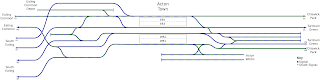
A simplified, schematic diagram of the track layout around Acton Town. Not to scale, relative positions may not be accurate
A more professional signalling diagram of Acton Town, showing depot roads (on the left), the station itself (in the middle) and tracks to the East (on the right). Image provided courtesy of "District Dave" (http://www.districtdave.co.uk/html/acton_town.html)
The second (oh yes, there's two) signalling diagram of Acton Town showing the area to the east of the station. Image provided courtesy of "District Dave" (http://www.districtdave.co.uk/html/acton_town.html)
As you can see, it's quite complicated. The main things to appreciate are:
  • Trains from South Ealing and Ealing Common (whether District or Piccadilly line trains) can be routed onto eastbound platform 4 and eastbound platform 3
  • Trains from eastbound platform 4 can proceed onto Chiswick Park (on the local line) or onto Turnham Green (on the fast line) via the crossover
  • Trains from eastbound platform 3 can only proceed to Turnham Green, however, any train approaching Acton Town on the eastbound can be routed into platform 4 as well as platform 3 (as explained in my first bullet point) so this isn't a huge problem
  • Trains on the fast line (from Turnham Green) can be routed into westbound platform 2 and westbound platform 1
  •  Trains from westbound platform 1 and westbound platform 2 can be routed onto either Ealing Common or South Ealing
  • Trains on the local line (from Chiswick Park) can only proceed into westbound platform 1, however, trains can reach Ealing Common and South Ealing (as explained in my previous bullet point) from here, so this isn't a huge problem
The upshot of this is that any eastbound train can be routed onto the local (in general, District) line, or onto the fast (in general, Piccadilly) line. Furthermore, any westbound train from the local line, or the fast line, can be routed onto South Ealing or Ealing Common.

Okay, the next station east of Acton Town is Chiswick Park:
A diagram showing the track layout around Chiswick Park
A view from westbound platform 1 at Chiswick Park looking west towards Acton Town. (Image courtesy "Sunil060902" (via Wikipedia))
As you can see, Piccadilly line trains (from now on, unless otherwise stated, I will refer to the fast lines as the Piccadilly line, since that's the service pattern almost all the time; likewise I will refer to the local lines as the District line) do not stop here - there are no platforms for them to stop at.

After Chiswick Park, both the District line and the Piccadilly line reach Turnham Green:
A diagram showing the track layout around Turnham Green
A view from eastbound platform 4 at Turnham Green looking west towards Chiswick Park and Acton Town. (Image courtesy "Sunil060902" (via Wikipedia))
As you can see, to the west of Turnham Green, eastbound District line trains from Gunnersbury (ex Richmond) merge with eastbound District line trains from Chiswick Park (ex Ealing Broadway or Acton Town). As is obvious, westbound District line trains can also proceed to Gunnersbury or Chiswick Park. Now, on to the Piccadilly line. Clearly, there're two island platforms (an eastbound platform and a westbound platform) which each split the District and Piccadilly lines in the relevant direction. These platforms are theoretically split in half: the District always stops at the outer platforms, while the Piccadilly serves the inner platforms "until 0650 Mondays to Saturdays, 0745 Sundays and after 2230 every evening". Picc trains may also call at Turnham Green if there're some problems or service disruptions and pressure needs to be relieved on the District line. The reason for this non-stopping is something like this (as I say, I just get on 'em, so I don't know the full story): essentially the reason for the four tracks is, I think, historical. Either way, we've got four tracks, we might as well use them. The "local" stations are sufficiently quiet that the District will do, there's no real risk of overcrowding nor is there the serious demand you get somewhere like Bank. Ultimately, the District line is good enough to serve these stations. The Piccadilly, therefore doesn't really need to stop at them (Chiswick Park is actually the only station with no Piccadilly line platforms and the Picc could stop elsewhere). Furthermore, the Piccadilly line is the express line, built for long, cross-city journeys and such and many people on it will be going down to Heathrow (or all the way up to Uxbridge for that matter) and they have a long journey and need to get a move on. In short, the District is all the local stations need, whereas the Picc really needs to get on to Acton Town, which is why it misses out stations. At Turnham Green, there're platforms in both directions, so here is somewhere it could stop. It doesn't for most of the day, for the reasons above, but at other times of the day, I imagine it stops at Turnham Green to supplement the District line service. Also, with the peaks over, the immediate need to get Piccadilly line passengers on their way is reduced. This is the quiet time of day, therefore the Picc might as well stop at Turnham Green. Turnham Green in particular (rather than any other station where it could stop) is stopped at because it's a very useful interchange for the Richmond branch and also because it sees a fair number of passengers. Consultations are, in fact, taking place to explore the possibility of stopping more (or all) Piccadilly line trains at Turnham Green.

Now, on to Stamford Brook, where we have an interesting arrangement:
A diagram showing the track layout around Stamford Brook
A view from eastbound platform 3 at Stamford Brook looking west towards Turnham Green (just visible in the background). (Image courtesy "Sunil060902" (via Wikipedia))
As you can see, there is no platform on the eastbound Piccadilly line, but there is one on the westbound Picc. This, however, is not used, except perhaps very rarely. The District line, meanwhile, uses the outer platforms (1 and 3).

Finally, at Ravenscourt Park, we have the same arrangement as at Turnham Green:
A diagram showing the track layout around Ravenscourt Park
A view from eastbound platform 4 at Ravenscourt Park looking west towards Stamford Brook and Turnham Green. (Image courtesy "Sunil060902" (via Wikipedia))
The Piccadilly line platforms, in this case, however, are extremely rarely used. They may see some use during service disruption and engineering work, but otherwise they aren't used. There have been calls, most notably by London Assembly member Murad Qureshi, to have the Picc call here regularly, but I doubt they will be answered.

Finally, we have Hammersmith and Barons Court, which really have to be treated together:
A diagram showing the track layout from Barons Court to Hammersmith
It's no Acton Town, but - as you can see - it's quite complicated. The "take home message" though is this:
  • Eastbound trains from Ravenscourt Park on the local line arrive at Hammersmith's eastbound platform 4, from where they can proceed onto eastbound platform 4 at Barons Court and from there to West Kensington (on the District line) or onto eastbound platform 3 at Barons court and from there onto Earl's Court (on the Piccadilly line). Because of the width of the tunnels, only Piccadilly line trains can do the latter and I doubt they ever do the former either
  • Eastbound trains from Turnham Green on the fast line arrive at Hammersmith's eastbound platform 3, from where they can proceed onto eastbound platform 4 at Barons Court and from there to West Kensington (on the District line) or onto eastbound platform 3 at Barons court and from there onto Earl's Court (on the Piccadilly line)
  • Westbound trains from West Kensington on the District line arrive at Barons Court's westbound platform 1, from where they can proceed onto westbound platform 1 at Hammersmith and from there to Ravenscourt Park (on the local line) or onto westbound platform 2 at Hammersmith and from there onto Turnham Green (on the fast line)
  • Westbound trains from Earl's Court on the Piccadilly line arrive at Barons Court's westbound platform 2, from where they can proceed onto westbound platform 1 at Hammersmith and from there to Ravenscourt Park (on the local line) or onto westbound platform 2 at Hammersmith and from there onto Turnham Green (on the fast line)
Or, in short, eastbound trains from both the fast lines and the local lines can be routed into the District line platforms at Barons Court (and continue to West Kensington and off along the District) or the Piccadilly line platforms there (and continue to Earl's Court and off along the Picc). In the other direction, westbound trains from Earl's Court and West Kensington can be routed onto the local line (the District) or the fast line (the Picc) and, from there, they proceed to Acton Town (stopping, or not, at the intermediate stations) and on to their final destination (or up a siding, of course, if they're terminating at Acton Town). Trains can also terminate at Hammersmith and run up the siding.

Phew. So, the upshot of all that is this: Both District and Piccadilly line trains can use both the fast (not stopping at any stations (except Turnham Green at some times)) and the local (stopping at all stations) lines between Hammersmith and Acton Town. The usual pattern, though, is perfectly represented by the tube map, with the Picc using the fast and the District the local.

So, why am I telling you all this? Well, partly because I find it interesting, but mostly because on Sunday (when I went on a trip to sample the various unusual workings due to the engineering works at Earl's Court) there was no District line service here at all. As a result, the Piccadilly line trains were being routed onto the local lines, with all Piccadilly line trains serving all stations (except when some occasionally had to be sent up the fast lines to relieve congestion/deal with late running/deal with problems elsewhere on the Picc, etc.). This gave me a rare (although far from being unheard of) opportunity to travel on a Piccadilly line train calling at the local stations. Apparently I wasn't the only one bowled over by the novelty - I heard tell that one Piccadilly line T/Op didn't stop at Chiswick Park because "we don't normally stop there and it was too late once I'd realised."

Even more excitingly, because there was no District line, Piccadilly line trains were being sent up to Ealing Broadway. A 1973 stock train at Ealing Broadway was just too much for me to miss; it may have been a unique opportunity.

Trains leaving Ealing Common pass over Hanger Lane junction. At this point, I should draw one of my diagrams of Hanger Lane junction, showing you what happens, but I've had quite enough of fiddling around with blue and green lines and the tube map actually does a perfectly adequate job. On the approach to Hanger Lane junction is a signal some of you may remember from a previous post which for some reason has two numbers:
The signal controlling Hanger Lane junction. Image courtesy "District Dave" (http://www.districtdave.co.uk/html/signalling.html)
For whatever reason, it's WM20 when the route indicator is on (as in the above picture) and the District line route to Ealing Broadway is set, and WM21 when the route indicator is off and the Piccadilly line route to North Ealing is set. So anyway, that's basically Hanger Lane junction: Coming from Ealing Common, you turn left as a District line train to go up to Ealing Broadway, and head straight on as a Piccadilly line train to go up to North Ealing. Obviously in the other direction it's a simple case of District line trains from Ealing Broadway heading along a right hand curve and merging with the Piccadilly line tracks coming straight down, a bit like on the tube map.

Oh, what the hey, here's a diagram of Hanger Lane Junction:
Hanger Lane junction
This is the source of the wonderful forum signature of the sadly departed "District Dave" (founder of the website I borrowed that picture above from):

"Oh - you mean I was supposed to turn left at Hanger Lane then Controller?"

Anyway, the reason behind the rambling is to explain that there's nothing in terms of the infrastructure to stop you running Piccadilly line trains to Ealing Broadway, it's just a matter of setting the points. And so that's what they did. The trouble was that Piccadilly line T/Ops aren't trained over that route, so I believe there were District line IOps (Instructor Operator) in the cab. I'm not sure who was driving and who was directing, but I imagine (since I can't see any reason why District line IOps would be trained on the 1973 stock and getting them moving is more difficult than obeying speed limits) it was the Piccadilly line T/Ops driving, with the District line IOps flagging up speed limits, signals and the like. Anyway, it's not far, which is what made it feasible.

And so:

I got up bright and early and headed down to ROV, where the WOO train was just sitting. At this stage I'd resigned myself to the 20 minute wait and was ambling over to the platform, waiting for it to pull out without me. But it didn't. I heard a train going over Woodford junction (which I assumed was from BUH (Buckhurst Hill)) as I reached the platform feeling triumphant and smug. Then the doors started beeping at me. Apparently it was a train from WOO heading to BUH and I had to hop on just in time. Happily, I got to WOO without any problems and was soon on my way to EAB (Ealing Broadway). Well, actually, I was on a NOR (Northolt) train and had to change at NOA (North Acton), which I don't mind at all - beautiful station, very quaint. It was a nice journey, seeing the stations beyond Holborn again and I pulled into a beautifully sunlit EAB feeling quite excited. And I didn't have long to wait before I saw the 1973 stock making its way into EAB. I had a nice chat with another nerd, who gave me a good tip for seeing battery locos. Battery loco(motive)s are just the name given to electric trains powered by batteries, but London Underground make good use of theirs for hauling engineering trains when the current is off for engineering work. They look like this:
London Underground battery loco. (Image courtesy "Sunil060902" (via Wikipedia))
I saw one just outside westbound platform 1 at Barons Court, which was where the possession began. (What this means is that the railway is in the possession of the engineers. This continues until they've finished, everything has been assured as safe and everyone is clear of the railway. Then, the possession is handed back to London Underground.) I also saw one on the eastbound at Chiswick Park when I was heading west and another approaching Acton Town on the eastbound.

Anyway, I hopped on the 1973 stock train and took it as far as Barons Court, in order to sample the local line running, before heading back to Boston Manor (again on the local lines) where there are superb views of the Northfields depot. The reason, though, was that I wanted a chance to use the local lines between Acton Town and Boston Manor (well, actually, the local lines merge with the fast lines just outside Northfields) on the Picc. If you look at the diagram of Acton Town, you'll see that there are four tracks going down to South Ealing, and the outer ones, visible here at South Ealing:
A view from westbound platform 3 at South Ealing looking west towards Northfields. Clearly visible on the left is the local line and its platform (westbound platform 4). The westbound fast is to the immediate right and the eastbound fast right of that. The eastbound local is out of shot on the far right. (Image courtesy "Sunil060902" (via Wikipedia))
Are the local lines and, technically, South Ealing and Northfields could be non-stopped on the fast lines. In reality, most trains these days go via the fast lines and they all stop at all stations, which is why I wanted a go on the local lines when I heard they were being used. I'm pretty sure I got a go on the way down to Boston Manor and had thought I was on the local lines on the way back, but I could be hopelessly mistaken because, thinking about it, we were held outside Acton Town on the eastbound (on what can only have been the fast line) waiting for a battery loco (and then a train from Ealing Common) to pass ahead of us. Must be getting old, can't remember which is which :P

Anyway, when I did reach Acton Town, I decided to go back to Ealing Broadway (nice to do the thing properly, both directions and all that) taking a Rayners Lane train to Ealing Common and changing for the next train through to Ealing Broadway. There I took the Central back to charming NOA and ran up to WER (West Ruislip) before doing the full trip up to EPP. It was a wonderful journey. The Sun was quite low which did affect the view on the WER branch a bit, but who cares? it was still beautiful and I was able to make EPP in the last few minutes of daylight, giving me a view of the beautiful fields up round there. At EPP I ended up meeting a friend and didn't get back to THB (Theydon Bois) until quite late. As such, by the time I made WOO there was a train in westbound platform 1 and a few in the sidings, which were joined, as I arrived, by a train from 21 road. Unfortunately, it arrived behind the others, so I couldn't really see much of it, but it was nice to witness what I wrote about back in "Woodford station". While I was there, there was someone (probably a couple of people, actually) checking all the doors, bells and whistles were working to make sure it was still fit for service. I don't know, but judging by the T/Op I saw walking away from the one that had come in off 21 road, I think this might have been the job of a fitter, who had travelled to WOO specifically for the purpose. I don't think this is done by T/Ops, but I could be wrong. The one who brought the train in off 21 road got on the next EPP train (presumably heading up to LOU (Loughton), where there's a crew depot.) Anyway, though cold, I soon made the WOO train home.

And that would ordinarily be that, but while writing about Hanger Lane junction, I was reminded of an RAIB (Rail Accidents Investigation Branch) report which I happened to come across and read the other day. This dealt with a near miss at Hanger Lane junction, which I think is interesting enough to warrant a few paragraphs :P The full report is available here: http://www.raib.gov.uk/cms_resources.cfm?file=/100322_R052010_Hanger_Lane.pdf and it makes for fascinating reading - very accessible to the layperson, too, which did surprise me. Anyway, I'll do my best to summarise it here:

On 27/03/2009, a District line train (number 103) passed signal WM1 at danger. Signal WM1 is shown on my diagram of Hanger Lane junction and it protects the junction, as well as controlling access to it, from/for trains from Ealing Broadway. "Danger", in railway terminology, refers to a red signal and this type of incident is called a SPAD (signal passed at danger).

Before reaching WM1, trains from Ealing Broadway first encounter signal WM100 (74 m before WM1). WM100 is involved in speed control signalling and it helps to prevent a crash from occurring at Hanger Lane junction. The consequences of a train passing signal WM1 at danger and failing to stop before it had travelled onto the junction could be catastrophic if a train to/from North Ealing were to collide with it. As a result, if signal WM1 is at danger (is red) signal WM100 will also be red until track-side equipment detects that the train is travelling at no more than 10 mph. Then, and only then, will signal WM100 clear to green. Also provided, on the same signal post, is a repeater signal RWM1. RWM1 is yellow if WM1 is red and green if WM1 is green. This gives the driver of a train approaching WM1 additional warning. RWM1 is off if WM100 is red. All of this is well-explained in the report, but since I've taken on the job of summarising it, I'll provide my own diagram here to help make things clear:
1. When signal WM1 is at danger, WM100 is also at danger until an approaching train is travelling at no more than 10 mph. RWM1 is off because WM100 is at danger. So, let's suppose that a train from Ealing Broadway is approaching at >10 mph and WM1 is at danger. This is how the signals would be. This is also how they would be if no train were approaching at all. WM100 only clears to green when a train has been verified as travelling at no more than 10 mph, or when WM1 clears to green.
2. When signal WM1 is at danger and there is a train approaching at no more 10 mph, signal WM100 clears to green (or "proceed"). RWM1 then comes on and is yellow because WM1 is at danger. This, then, is what happens next when our train from Ealing Broadway has slowed down to 10 mph or less.
3/1b.  When signal WM1 is green, WM100 is also green. Since WM1 is green RWM1 is green. So, if our train from Ealing Broadway had slowed down to 10 mph or less and then WM1 cleared to green before it had passed WM100, the T/Op would see green over green. This is also how the signals would be if WM1 had been cleared before a train had begun to approach, however fast it was travelling.
So how does this help? All signals on manually driven lines have trainstops, which look like this:
A raised trainstop. (Image courtesy "District Dave" (District Dave signalling))
When the signal is red, the trainstop is raised (like in the picture above). All manually driven trains are fitted with tripcocks, which will hit the raised trainstop, if they pass the signal at danger. On these trains, the emergency brakes are held off by air pressure in the brakes. When the tripcock hits the trainstop, it releases the air from the brakes and so the emergency brakes come on, stopping the train automatically. Obviously, if the signal is green, the trainstop is lowered and it carries on as normal. So how does this help? Well, the point is that, if a train passes signal WM1 at danger, it will be tripped to a halt and so should not reach the junction and cause an accident. Or at least, that's what you want to happen, but what if the train's going too fast and it can't stop in time? That's where WM100 comes in. WM100 also has a trainstop, which will not lower until the approaching train is travelling at no more than 10 mph. If it's travelling at >10 mph when it passes WM100, it will be tripped to a halt long before it's reached the junction. That way, it is ensured that the train is travelling slowly enough that, when it reaches WM1, if it should pass it at danger, it cannot reach Hanger Lane junction and cause an accident. RWM1 also helps by providing additional information about the aspect of WM1. Obviously, if WM1 is green, there is no need to enforce this 10mph speed limit, because the train can safely proceed onto the junction as normal, travelling at full line speed. This is why WM100 is green when WM1 is green, whatever the speed of the approaching train.

This is WM1; naturally, there are other signals protecting and controlling Hanger Lane junction. Signal WM2 is the station starter signal at North Ealing and controls passage over Hanger Lane junction for Piccadilly line trains from North Ealing. Our old friend signal WM21 obviously controls passage straight on over Hanger Lane junction for Piccadilly line trains from Ealing Common. (WM20, as mentioned above, controls passage onto Hanger Lane junction for District line trains heading to Ealing Broadway. However, trains taking this route will not cross the path of any other train.)

So, that's the safety equipment, back to the near-miss. In this case, everything essentially worked as designed. Train 103 left Ealing Broadway at 17:21 and headed on towards Hanger Lane junction. As the train was approaching, WM1 was at danger and so, therefore, was WM100. The T/Op dutifully slowed his train to <10 mph and WM100 cleared to green. RWM1, of course, turned yellow which, it appears, was not recognised by the T/Op. The T/Op failed to correctly sight WM1 as being at danger and did not notice, until it was too late, that the tripcock was raised. Immediately, he applied the emergency brakes, but passed WM1 at danger, at low speed. The train was tripped to a stop, only about 5 m from WM1, well short of Hanger Lane junction, at 17:23.

The T/Op presently left his cab and informed the signaller of the incident by means of the signal telephone. The signaller undertook various actions in an attempt to make the area safe for train 103 to proceed across Hanger Lane junction. This would obviously require that no train be allowed to cross Hanger Lane junction to/from North Ealing, for the paths of the two trains would intersect, almost certainly causing an accident. To achieve this, the signaller held the Piccadilly line train that was at North Ealing on the eastbound (train 340) in North Ealing (at signal WM2). This train could not, therefore, proceed onto Hanger Lane junction. Train 252, the previous eastbound Piccadilly line train from North Ealing had already cleared Hanger Lane junction and would not be a problem. The Piccadilly line train approaching Ealing Common on the westbound (train 326) was also held at signal WM23A. This prevented the train from entering Ealing Common and, therefore, prevented the train from proceeding towards Hanger Lane junction. The signaller informed the T/Op of train 103 of what he had done and instructed the T/Op on the action he should take, telling him "carry out that procedure, OK?"

Although, I believe, the signaller maintained that he had not intended to clear train 103 onto Hanger Lane junction, the T/Op believed himself cleared to proceed onto the junction and began preparing to move his train. Unfortunately, the signaller had neglected to hold the westbound Piccadilly line train (316), which had been at Ealing Common, heading towards North Ealing and on to Uxbridge, when he had undertaken action to hold the other trains. While everything else was happening, train 316 had left Ealing Common and signal WM21 had cleared train 316 over Hanger Lane junction (WM21 is a semi-automatic signal, as - in fact - are all of the signals I've been discussing, which means that it is usually controlled by the signalling computer, but can be operated manually by the signaller. In this case, the signaller had not taken control of WM21 and it cleared automatically, for train 103 had not passed far enough past WM1 to alert the computer that it was not safe to clear WM21). 316 presently passed over Hanger Lane junction as the T/Op of 103 was preparing to move his train. Had the T/Op got his train moving earlier, it would have been a bad day to be on the tube.

Happily, it was just a near-miss, nothing came of it. Indeed, it's important to remember just how safe the tube is and just how rare major accidents are. The vast majority of the few serious incidents on the tube are not accidental and the number bandied about on the Wikipedia page (taken from a 2003 article in the Economist) suggests that there is(/was) only one fatal accident for every 300 million journeys. One of the reasons for this, of course, is full and open investigations, like these, and prompt and appropriate responses to the results. Another, of course, is the safety equipment - some of which I've already talked about and a big one is the staff. Of which, it seems, we will get fewer; but that's what happens when you put a TV idiot in charge of running a major capital.